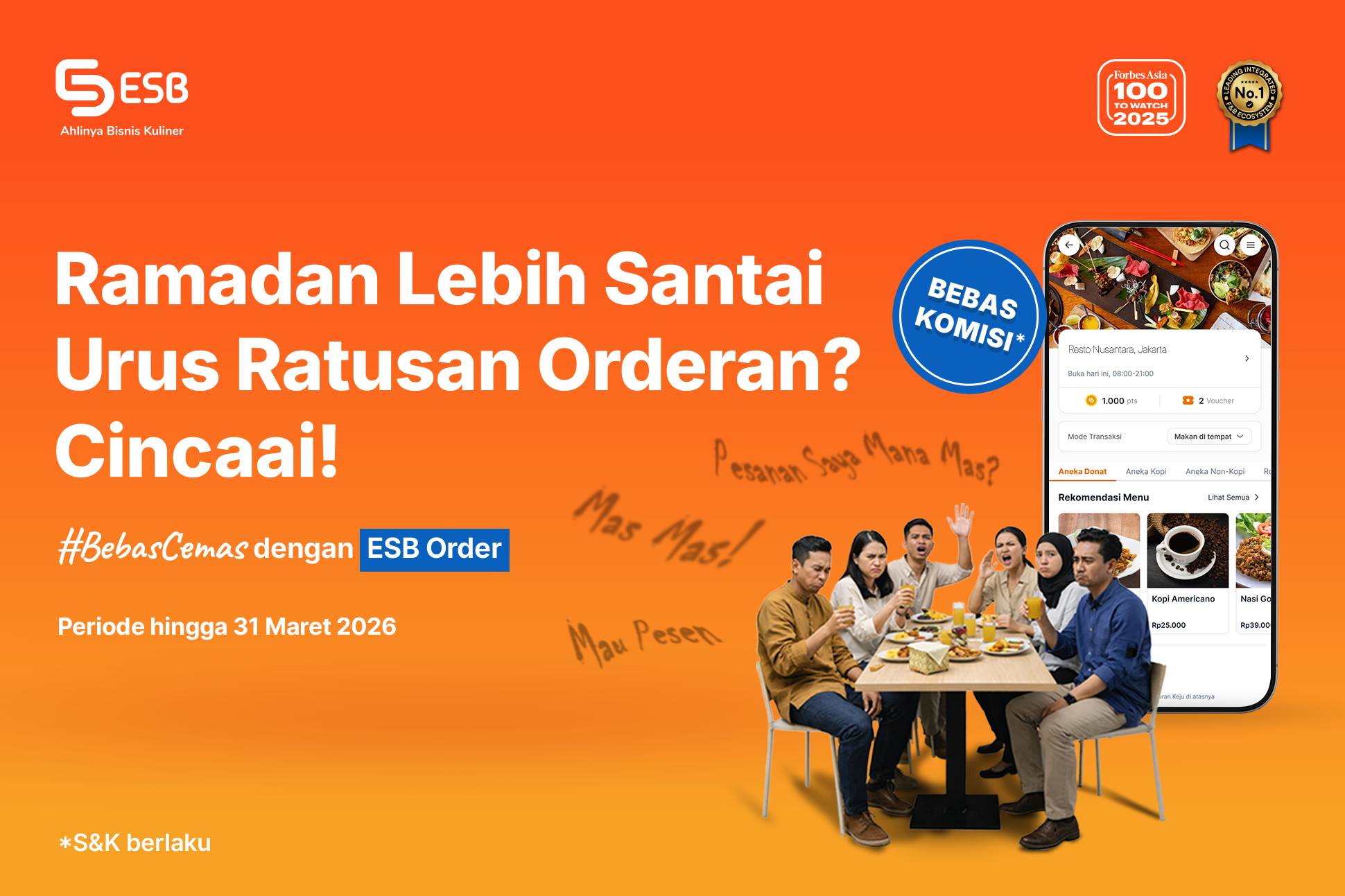
Ramadhan has always been an important momentum for culinary businesses in major cities such as Greater Jakarta, Bandung, Surabaya, Yogyakarta, and Semarang.
Iftar gatherings, sahur activities, and increased public mobility often cause restaurant traffic to spike within a relatively short period of time.
However, behind the potential revenue growth lies an operational challenge that cannot be ignored.
In the hour leading up to iftar, dozens of orders can arrive almost simultaneously.
Waiters must move quickly, record orders accurately, ensure no menu items are missed, and maintain service quality at the same time.
When systems are still manual or not fully integrated, the risk of input errors and long queues increases significantly.
This is where system readiness becomes more important than simply adding more waiters or manpower.
When Orders Arrive Simultaneously, Workflow Matters
An order surge during Ramadhan is not merely about increased transaction volume. The complexity is far greater than on regular days.
Within the same short timeframe:
-
Multiple tables place orders at once
-
The kitchen receives stacked tickets
-
Cashiers must ensure every transaction is recorded
-
Waiters must maintain service quality.
If the ordering process still relies on manual note-taking or repeated input, the risk of human error rises.
Small mistakes—such as incorrect menu entries, wrong quantities, or delayed kitchen notifications—can significantly impact the customer experience.
Ramadan customers tend to be more time-sensitive. They arrive with expectations of fast service, especially as iftar approaches.
At this point, workflow efficiency becomes crucial.
Adding More Staff Does Not Always Solve the Problem
Hiring temporary staff can help increase capacity. However, without a supportive system, additional team members still operate within the same workflow limitations.
When workload increases drastically within a short time, process speed and integration become more decisive factors than the number of people on the floor.
Some restaurants have begun recognizing that digital ordering systems can help restructure operational flow. One increasingly common approach is the QR Order system, allowing customers to place orders directly from their tables.

Source: ESB Documentation
With this mechanism, orders are recorded automatically in the system and integrated with both cashier and kitchen operations without the need for re-entry.
The process becomes more streamlined, queues can be reduced, and waiters can focus more on service and on-site coordination.
For some merchants, systems like ESB Order function as an “operational backup” during peak traffic periods. Not to replace staff, but to help maintain workflow stability during peak hours.
Protecting Margins Amid Rising Transactions
On the other hand, many business owners also consider cost factors when adopting digital systems.
Concerns about commission fees often become a separate consideration.
This is why commission-free models become more relevant during periods like Ramadan.
As transaction volume increases, maintaining intact margins becomes just as important as increasing order numbers.
In this context, using an ordering system that does not charge commissions per transaction can help businesses optimize revenue growth without additional pressure on profitability.
Faster Systems, More Professional Service
A QR Order system helps accelerate the ordering process and reduce queues, especially during iftar hours when traffic peaks.
Orders go directly into the system without manual intermediary steps, minimizing miscommunication with the kitchen.
For customers, the dining experience becomes smoother and more comfortable. For restaurants, operations become more controlled and organized.
Ramadan, often associated with togetherness and time efficiency, makes service speed an even more critical factor.
Time for Your Restaurant to Get Ready for Ramada
Ramadan is always associated with increased traffic. However, what truly makes a difference is not how crowded the restaurant becomes, but how prepared the system is to handle the surge.
Efficient ordering workflows, integration with kitchen and cashier systems, and adaptive manpower management will strongly determine service quality during peak periods.
In an increasingly dynamic competitive landscape, operational readiness becomes a long-term investment—not only for this Ramadan, but for future peak seasons as well.
The question is no longer whether traffic will increase.
The real question is whether your system is ready to manage it with ESB Order. Contact the ESB Team now!


