
In the dynamics of the business world and social life, money lending and borrowing transactions are inevitable.
For an entrepreneur, debt is often an instrument for capital expansion, while receivables are a form of trust given to partners.
However, behind this convenience, there is a big risk of disputes if it is not based on strong legal documents.
Here it is Debt Receivables Agreement Letter (SPHP) plays a crucial role as a legal defense for both parties.
Many people underestimate the importance of creating this document due to "trust" or kinship factors. However, without a valid written document, a financial transaction has no legal validity.
This article will thoroughly explore everything you need to know about debt agreements, from their definition, mandatory components such as witnesses and stamps, to how to integrate them with modern business solutions.
Definition of Debt Agreement Letter
Legally, a debt agreement is a written document that is legally binding between two parties, namely creditors
(the party providing the loan) and Debtor (the party receiving the loan).
This document refers to Article 1320 of the Civil Code (KUHPer) regarding the requirements for the validity of an agreement.
The contents of this letter record the figures, and also contain a manifestation of the intention of both parties to be bound by the agreement, including rights, obligations, time periods, and sanctions.
Without a written document, the debt-credit relationship is only verbal and is very weak if at any time one of the parties defaults (breaks their promise).
Read also: How to Create a Delivery Note: Definition, Components, Types, and Examples for Business
Benefits and Role of Debt Agreements in Business
In the business ecosystem, especially in the MSME and culinary sectors which have very fast turnover, this agreement letter has multi-functional benefits:
- Providing Legal Certainty: This letter is the basis if the case must be brought to civil or criminal court.
- Avoiding Disputes: Since all the points are written down, there is no room for either party to claim to have "forgotten" or provide a different interpretation at a later date.
- Financial Monitoring Tools: In business accounting, this letter is the basic evidence for recording liabilities (debts) or current assets (receivables) in the balance sheet.
- Credit Application Requirements: Often, neat proof of accounts receivable is a requirement when business actors want to apply for additional financing from financial institutions or investors.
- Maintaining Good Relationships: Ironically, a written agreement actually maintains the relationship. With clear boundaries, both parties can interact professionally without suspicion.
Mandatory Components in a Debt-Receivables Agreement Letter
A written agreement is considered legally "enforceable" if it meets the following requirements. Make sure nothing is missing:
1. Complete Identity of the Parties
Don't just write your nickname. Include your identity as it appears on your ID card, including:
- Full Name
- NIK (National Population Identification Number)
- Place and date of birth
- Current Residential Address
- Job/Position (if representing a company)
2. Total Debt (Loan Principal)
Write the specific amount. It is highly recommended to use both numbers and letters (in words). Example: Rp. 50,000,000.00 (Fifty Million Rupiah).This is to prevent manipulation by adding zeros behind the day.
3. Payment Period
Determine a definite due date. Whether the loan is short-term (e.g., 6 months) or long-term. This clarity of time determines when a debtor can be legally declared "in default."
4. Payment Scheme
Will the debt be paid all at once (lump sum) on a specific date, or through monthly installments? If installments, create an installment table that details the principal and interest each month.
5. Interest Rate (If Any)
In business, it is natural to have interest as compensation for the time value of money (time value of money). Ensure the interest rate is agreed upon in advance and does not violate applicable legal provisions to avoid being considered a burdensome usury practice.
6. Rights and Obligations
Creditors have the right to receive timely payment, while debtors have the right to receive the funds in full as agreed. It is the debtor's responsibility to maintain communication if payment issues arise.
7. Penalties and Fines for Late Payments
This matterThis is the most important part of creating a deterrent effect. Include the daily fine for late payments. Furthermore, mention any collateral that can be seized if the debtor fails to pay completely.
8. Witnesses
Have at least two neutral witnesses (not immediate family members) present to witness the signing process. These witnesses will be invaluable if one party denies signing the document in the future.
9. Stamp and Signature
In accordance with the latest Stamp Duty Law, use a Rp10,000 stamp. The signature must cover part of the paper and part of the stamp. The stamp is required for documents to be admissible as evidence in court.
Read also: Want to Offer a Price to a Client? Here’s an Effective Individual Price Quotation Letter Example
Stamped vs. Unstamped Debt Agreements
There's a widespread myth that agreements without a stamp are invalid. Let's set the record straight legally:
- Validity of the Agreement: Based on Article 1320 of the Civil Code, an agreement remains valid even without a stamp as long as it meets the requirements (agreement, capacity, certain matters, and lawful reasons).
- Strength of Proof: Here's the difference. If you bring a letter without a stamp to court, the judge will ask you to "Seal it Later" (nosebleed). Without a stamp, the document cannot be processed as evidence.
- Function of Stamp: A stamp duty is a document tax. Using a stamp duty from the outset demonstrates seriousness and simplifies legal proceedings in the event of a future default.
How to Make a Valid Debt Receivable Agreement Letter
Follow these procedural steps:
- Mediation Stage: The two parties met to determine the main points verbally.
- Drafting: Write your letter in standard Indonesian to avoid ambiguity. Use bullet points or articles.
- Joint Review: Reread the draft. Ensure there are no "trap" articles or provisions that unfairly disadvantage one party.
- Document Preparation: Prepare your ID card, stamp, and if any, collateral documents (such as SHM or BPKB).
- Execution: Sign the document together in front of witnesses. Do not sign a document that is blank or incomplete.
Example of a Simple Debt Receivable Agreement Letter

Source: greatdayhr.com
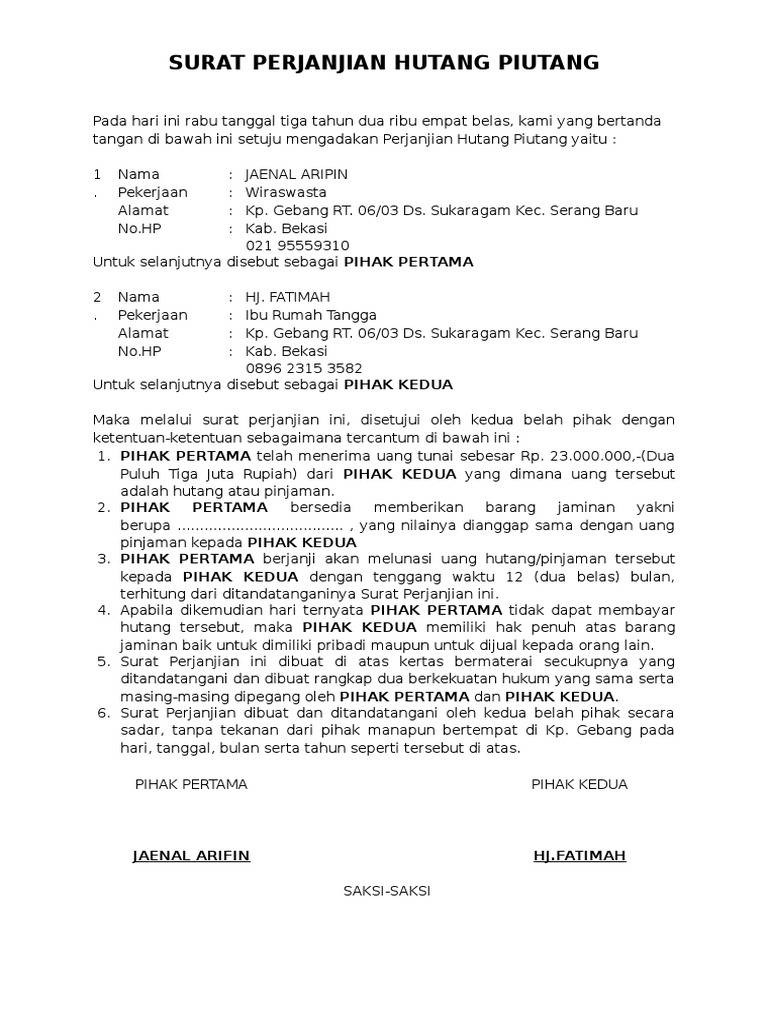 Source: greatdayhr.com
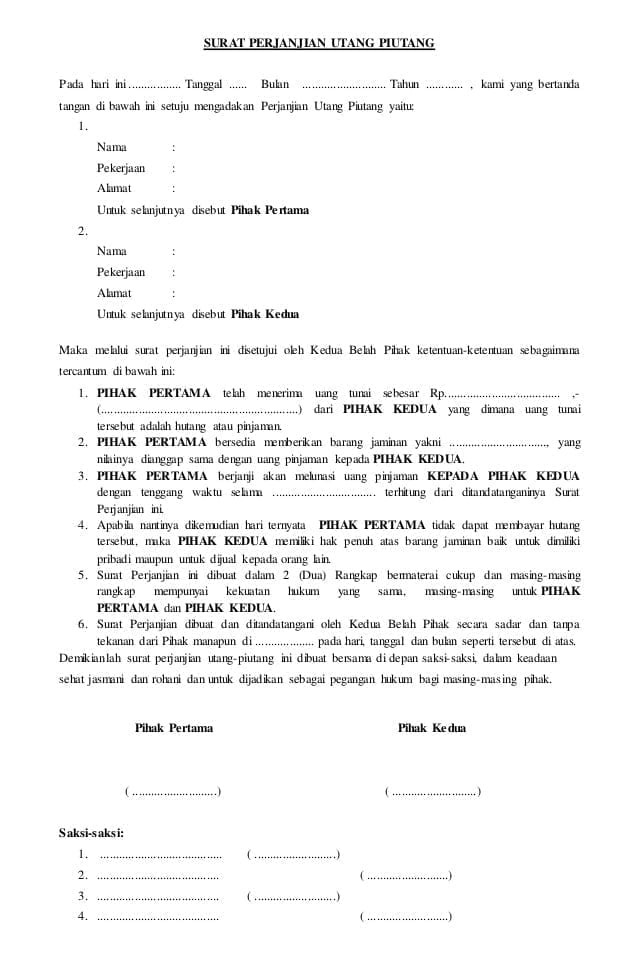 Source: greatdayhr.com
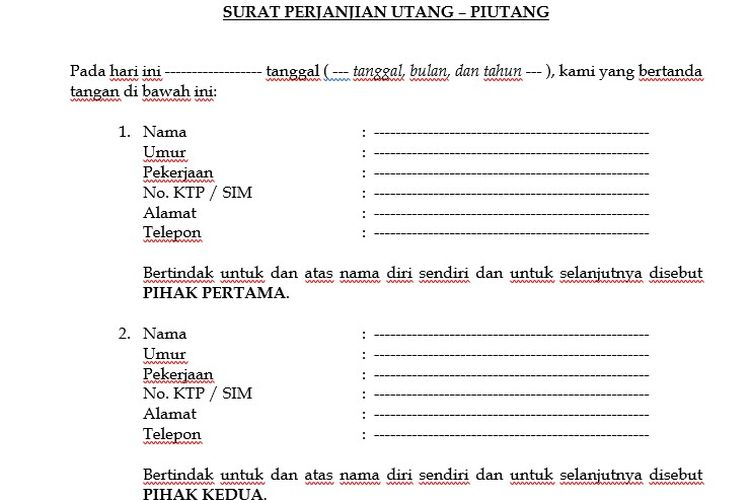
Source: kompas.com
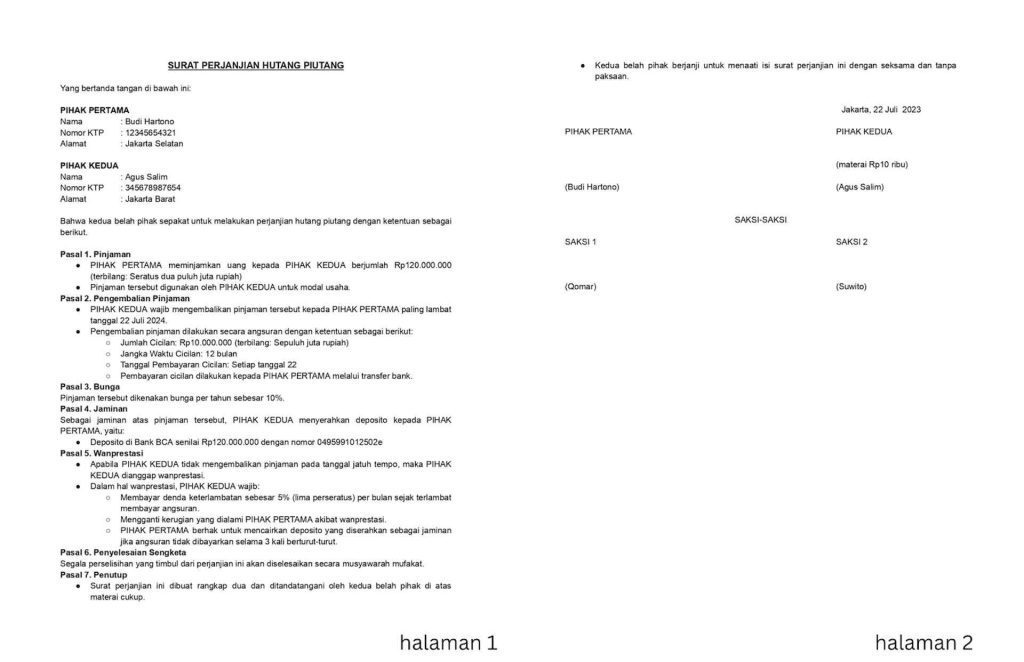
Source: advance innovations
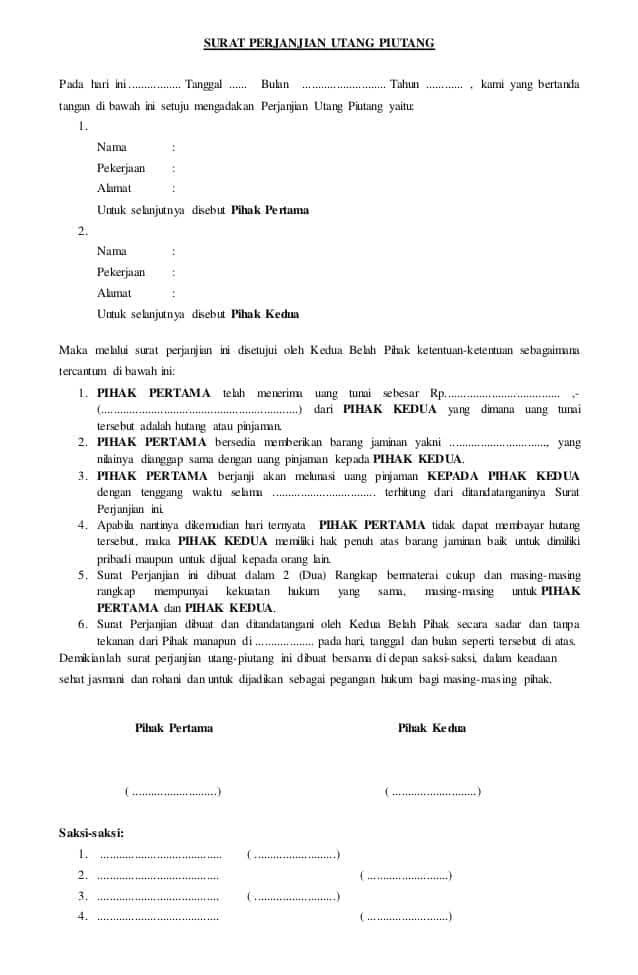
Source: Mekari
Mistakes to Avoid
Don't let your good intentions end up in court because of the following silly mistakes:
- No Date Included: Without a date, it is difficult to determine when the interest expires or starts to apply.
- Invalid Witness Data: Using false witnesses or unknown people will make it difficult to prove.
- Use of Complex Terms: Don't use legal terms you don't understand. Use clear language.
- Signature Does Not Match ID Card: Make sure the signature is identical to the official identity document.
- Ignoring Changes (Addendum): If there's a change in the payment schedule midway, create an addendum. Don't just send a WhatsApp chat without official documentation.
FAQ (Frequently Asked Questions)
1. Can WhatsApp chats be used as proof of debt?
It can serve as electronic evidence, but it's not as strong as a physical, stamped agreement. WhatsApp only serves as supporting evidence of the transaction.
2.What if the debtor runs away?
You can report to the police for fraud or embezzlement (Article 378 or 372 of the Criminal Code), as long as the agreement contains elements of deception or dishonesty that are proven from the start.
3. Can this letter be made without a notary?
Yes. A private letter (written by yourself) remains valid. However, a letter drawn up before a notary (an authentic deed) has absolute legal force and is more difficult to challenge.
4. What is the difference between interest and fines?
Interest is a fee for using money (applied every month), while a fine is a penalty for late payment (only appears if the debtor is late in paying).
Conclusion
Understanding the legality of debt agreements is a smart first step for any business owner. However, in managing a culinary or retail business, recording accounts receivable is just one of many operational challenges.
In order for your business to be not only legally secure but also financially healthy, an integrated management system is required. ESB presents as a strategic partner to help digitalize your business.
Don't let debt disputes or messy financial management hinder your business growth. It's time to switch to a more professional, transparent, and secure system with ESB.
Ready to take your business to the next level? Consult your business management and capital needs with our team of experts now. Contact ESB WhatsApp Now.


