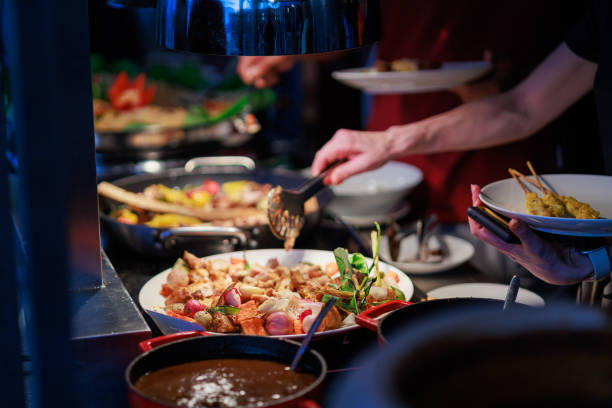
Owning a culinary business often requires making major decisions from the outset. One of these is the presentation style.
Many business owners are confused about choosing between a la carte and a buffet style because both have different characteristics.
This is where it's crucial to understand the concept from the start, so that the business strategy you choose aligns with your target market and long-term plans.This article will help you see the big picture.
We'll discuss the definition, types, and advantages of the buffet model in detail. So that in the end, you can decide for yourself which one is best for your business.
Definition of Buffet
Before we get into a more in-depth comparison, you need to understand the basic concept. A buffet is a food presentation style where customers are free to choose and take from the menu items available in a single serving area.
Typically, customers simply pay one price upfront, then can enjoy a variety of menu options according to the applicable terms and conditions.
In practice, the buffet system is often used in family restaurants, hotels, and even the all-you-can-eat concept.
This model offers greater flexibility, allowing customers to customize their own portions and food combinations. From a business perspective, the buffet system offers the opportunity for rapid customer turnover if managed effectively.
Interestingly, many businesses choose the buffet system because it creates a sense of value for money in the eyes of customers.
As long as inventory management and kitchen flow are well-organized, this model can be a promising strategy.
Read Also:What is All You Can Eat? Learn the definition and tips for eating a lot here so you don't lose out!
Types of Buffets
Now that you understand the definition, it's time to learn about the various buffets commonly found in the culinary world. Each type has its own characteristics and target market.
This understanding is important so that you don't make a mistake when applying it. The first type is buffet is the menu is served at specific times and rarely changes during operating hours.
This model is suitable for businesses with a stable mainstay menu and raw materials that are easy to control. Then there is thematic buffet. Usually present at certain moments such as weekends or special events.
Menus are created around a specific theme to make the dining experience more memorable. Many restaurants use this approach to attract new customers.The next type is interactive buffet.
This concept allows customers to directly observe the preparation process, much like live cooking. Besides increasing trust, this approach also creates a more lively atmosphere in the restaurant.
No matter which type you choose, a buffet system still requires careful planning to ensure smooth operations and a consistent customer experience.
Read Also:50 Promising Food Business Ideas with Low Capital, a Must-Try in 2026!
Benefits of the Buffet System

Sumber: istockphotos
Moving on to the most frequently considered aspect of a buffet system, the advantages of a buffet system extend beyond the diverse menu offerings, but also to the business strategy behind it.
First, this model makes it easier to set package prices. With a single, fixed price, customers feel more secure when ordering. From an operational perspective, you can more accurately predict revenue.
Second, the buffet system helps speed up the service process. Customers don't have to wait for their orders to arrive individually. They can simply pick up the food they want.
Third, this concept allows for menu efficiency. Ingredients can be processed in large quantities and used for multiple dishes simultaneously. If managed properly, the potential for food waste can be reduced.
Furthermore, the buffet system also supports branding strategies. Many customers are drawn to the menu out of curiosity and curiosity about the variety of dishes on offer. If their experience is pleasant, the likelihood of repeat orders increases.
Difference between Buffet and Banquet
At this point, it's important to clarify one common point of confusion. Buffets and banquets are often considered the same, even though they are different concepts.
Buffets focus on customer freedom in choosing their food. They come in, pick a menu, and then enjoy their meal at their own pace. This model is well-suited to daily restaurant operations.
Meanwhile, banquets are more often used for special events like weddings or corporate gatherings. Food presentation remains neat and organized. The number of guests and menu are usually determined in advance.
If you want a business with a dynamic daily flow of customers, a buffet style is more appropriate. Banquets are more suited as an additional service, not the restaurant's primary concept.
Understanding these differences will give you more confidence when deciding your business direction. You can avoid misconceptions that can lead to wasted costs.
Read Also:Understanding Ala Carte as a Flexible Menu System: Here's the Explanation
Buffet vs. Ala Carte: Which is Better for Your Business?

Sumber: istockphotos
Now that you've seen the big picture, you can start making realistic comparisons. À la carte offers complete control over portions and menu items, but often requires longer service times.
The buffet system offers speed and variety, but demands disciplined stock management. The best choice always depends on the target market, business location, and operational capacity.
Many business people are successful because they dare to adapt their concepts to market needs, not just follow trends. If you want a concept that attracts many visitors at once, a buffet system could be a strategic choice.
FAQs about Buffet and Ala Carte Systems
1. What is the difference between buffet and a la carte systems?
A buffet system allows customers to eat as much as they like for a fixed price. A la carte requires customers to order individually according to their preferences.
2. Which is more profitable for restaurants?
It depends on the business concept. Buffets are suitable for high volume and casual dining. A la carte offers advantages in cost control and menu flexibility.
3. When should a restaurant use a buffet system?
Buffets are ideal for special events, hotels, or restaurants targeting families and large groups. This model appeals to customers who want a varied menu at one price.
4. What are the advantages of the a la carte system compared to the buffet?
A la carte helps control portions, reduce food waste, and maintain the quality of the food. Furthermore, restaurants can adjust prices based on each menu item.
Digitizing Buffet Operations to Prepare Businesses for Growth
In today's era, even the strongest concept still requires technological support. This is especially true if you're running a buffet system that involves numerous transactions and daily stock movements.
This is where the ESB ecosystem comes in as a solution.EU POSLiteSuitable for those of you who want a practical cashier system with integrated delivery services such as GrabFood and GoFood.
Transactions remain secure even when your internet connection is unstable because data is stored locally before synchronization.
Sales reporting, table management, and inventory features help you manage your operations more efficiently.
Conclusion
If your business has grown or has more than one outlet, ESB POS, it's a more comprehensive choice. With Order Management System integration, you can manage orders from multiple channels in one dashboard.
Reports and AI support enable faster and more accurate decision-making. You can even monitor multiple branches simultaneously and increase sales potential through ESB Orders.
With the right technology support, a buffet system is not just about an attractive concept, but also about consistent and measurable execution.
It's time to level up and manage your culinary business smarter together. ESB POSLite And ESB POS.
Contact the ESB team if you are ready for digitalization and want your culinary business to grow faster, the ESB ecosystem is ready to be your reliable partner.


