Many business owners focus on dining room design, interior design, or promotions. However, the kitchen area is an operational aspect that determines the quality of daily service.
Well, of course, understanding restaurant kitchen standards, standard restaurant kitchen layout, until standard restaurant kitchen size is an important step before opening a culinary business.
What's more interesting is the discussion about standard restaurant kitchen sizes also closely related to cost efficiency, team productivity, and customer satisfaction.
The better the kitchen planning, the smoother the workflow will be. So what is it actually like? Restaurant kitchen standards? Which is ideal?
How much? Standard restaurant kitchen size? What are the recommended ones? So, how do you adapt them to different business concepts? Let's discuss them one by one.
Why Are Restaurant Kitchen Standards So Important?
When people come to a restaurant, they only see the food served on the table. Customers rarely know the lengthy process that goes on behind the kitchen.
After all, a restaurant's success is often determined by how the kitchen operates. This means, implementation/restaurant kitchen standards become the main foundation in culinary business operations.
A well-designed kitchen can speed up the cooking process, minimize errors, and maintain consistent food quality.
Besides that, restaurant kitchen hygiene standards are also easier to implement when the layout of the space has been planned properly.
The ingredient preparation area, cooking area, and washing area can be clearly separated so that the risk of cross-contamination is lower.
Read Also:Food Holding Time: Definition, Function, and Standards in Restaurants
What Are Restaurant Kitchen Standards?
Before discussing size, it is important to understand the definition first. Simply, restaurant kitchen standards is a guideline used to regulate the design, layout, cleanliness, safety, and efficiency of the kitchen area in a culinary business. This standard covers several important aspects such as:
- Employee workflow
- Equipment placement
- Material storage area
- Ventilation system
- Food distribution channels
- Hygiene system
Through the implementation of restaurant kitchen standards, operational activities can run faster and more structured.
It should be noted that because each restaurant has a different character, the implementation of standard restaurant kitchen sizes can also vary according to business needs.
Commonly Used Standard Restaurant Kitchen Sizes
After understanding the basic concept, now we move on to the most frequently asked question, namely how much does it actually cost? Standard restaurant kitchen size? The answer depends on the capacity of the restaurant.
As a general idea, the kitchen area usually takes up around 30% to 40% of the total area of a restaurant building. For example:
a. Small Restaurant
If the restaurant area is around 100 square meters, the standard restaurant kitchen size can range from 30 to 40 square meters. This size is usually suitable for:
- Food shop
- Small cafe
- Modern shop
- Small scale fast food restaurant
b. Secondary Restaurant
For restaurants with a building area of around 200 to 300 square meters, the kitchen usually has an area of between 60 to 120 square meters. This category is suitable for:
- Family restaurant
- Casual dining
- Thematic restaurant
In this category, the application standard restaurant kitchen sizes began to require a more detailed division of work areas.
c. Big Restaurant
Large restaurants or hotel restaurants can have kitchen areas of up to 150 square meters. Usually there are several separate kitchen sections, such as:
- Hot kitchen
- Cold kitchen
- Pastry section
- Beverage section
- Storage area
At this stage, standard restaurant kitchen layout becomes a factor that determines operational efficiency.
Efficient Standard Restaurant Kitchen Layout

Sumber: Istockphoto
Large size does not necessarily guarantee that the kitchen will work well. Therefore, besides paying attention to standard restaurant kitchen size, business owners also need to understand standard restaurant kitchen layout.
A good layout helps employees move faster without bumping into each other. In general, standard restaurant kitchen layoutconsists of several main areas.
1. Material Receiving Area
All raw materials enter through this area.Here, the quality and quantity of goods are checked before they enter storage.
2. Storage Area
Once received, food ingredients are stored according to their category. For example:
- Chiller
- Freezer
- Dry storage
This part is important in maintaining the quality of raw materials.
3. Preparation Area
In this area the following processes are carried out:
- Washing materials
- Cutting material
- Weighing ingredients
- Preparing the spices
The preparation area is an important part of standard restaurant kitchen layout.
4. Cooking Area
This is the center of kitchen activity. The stove, oven, fryer, and other cooking utensils are placed in this area.
5. Area Plating
Once the food is cooked, the dishes are tidied up and prepared before being served to customers.
6. Washing Area
This section is used to clean cooking utensils and cutlery.Separating the washing area helps to maintainrestaurant kitchen hygiene standardsmore optimally.
How to Adjust Kitchen Size to Your Business Concept
Sumber: Istockphoto
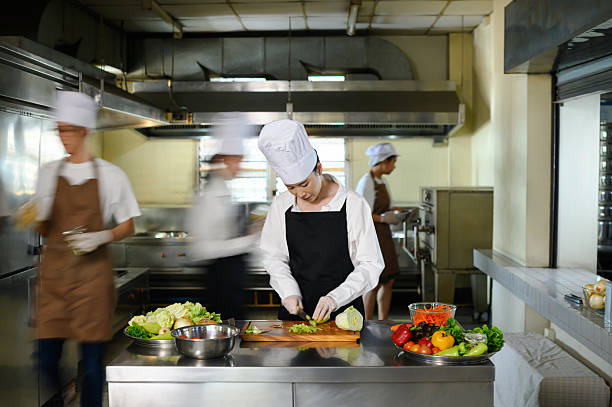
After knowing the general description regarding standard restaurant kitchen sizes, now it's time to adapt it to the business concept. Because the needs of each business are certainly different.
1. Cafe and Coffee Shop
Cafes generally have simpler menus. Therefore, the standard restaurant kitchen size for cafes can be smaller. The main focus is usually on the beverage and pastry areas.
2. Fast Food Restaurant
This concept requires speed of service. So, standard restaurant kitchen layout must be designed to support fast and repetitive work processes.
3. Family Restaurant
A more diverse menu means more space is needed. Implementing restaurant kitchen standards in this category usually require larger storage areas and preparation areas.
4. Fine Dining Restaurant
Fine dining demands high quality and detail. So,standard restaurant kitchen sizes in this concept are often bigger than a regular restaurant. Each part has a specific function so that the quality of the dish is maintained.
Read Also:Customer Retention Is Key to Business Success, Here's How to Improve It!
Restaurant Kitchen Hygiene Standards That Must Be Implemented
Apart from size and layout, cleanliness also plays an important role. Even the best-designed restaurants can run into problems if they neglect restaurant kitchen hygiene standards. Some basic principles that need to be applied include:
1. Clean the Work Area Regularly
Every work area must be cleaned after use. This method helps maintain food quality and work comfort.
2. Separating Raw and Cooked Materials
This step is important to reduce the risk of cross-contamination. This principle is an important part of restaurant kitchen hygiene standards.
3. Maintain Air Circulation
Good ventilation helps reduce excess heat and keeps the kitchen environment clean.
4. Controlling Storage Temperature
Food ingredients must be stored according to recommended temperature standards.
5. Perform Equipment Sanitation
All cooking utensils and cutlery must go through a proper cleaning process. When restaurant kitchen hygiene standards are implemented consistently, the quality of service will improve significantly.
Common Mistakes When Designing a Restaurant Kitchen
Unfortunately, many business people still make mistakes from the initial planning stage.
One of the biggest mistakes is making the kitchen too small in order to expand the customer area.As a result, the workflow becomes less efficient.
The next mistake is to ignore standard restaurant kitchen layout. Equipment is often placed without considering employee workflow.
The impact is that service times become slower. There are also those who ignore restaurant kitchen hygiene standards by placing the washing area too close to the material preparation area.
In fact, area separation is an important part of maintaining food safety.
So, in essence, understanding restaurant kitchen standards from the start can help avoid various operational risks in the future.
How Does Technology Help Optimize Kitchen Operations?
Once the kitchen size and layout are finalized, the next challenge is to ensure all operational activities run smoothly on a daily basis.
This is where technology starts to play a vital role. As orders increase, manual recording often slows down the work process.
Order input errors, delayed communication between the cashier and the kitchen, and inaccurate sales reports can impact business performance.
As a result, many modern restaurants are starting to incorporate kitchen standards with a digital system that is able to support operations directly.
As a result, the work process becomes faster, neater, and easier to monitor, you know!
FAQs About Standard Restaurant Kitchen Sizes
1. What is the ideal standard size of a restaurant kitchen?
NoThere's no one-size-fits-all size for all businesses. However, many restaurants allocate about 30-40% of the total building area to the kitchen area to maintain efficient operations.
2. What influences the size of a restaurant kitchen?
Some of the factors that influence this include the restaurant concept, number of seats, menu variety, production capacity, and the number of staff working in the kitchen.
3. Does a small restaurant need a large kitchen?
Not always. Restaurants with simple menus can usually operate with a more compact kitchen as long as the workflow and equipment placement are well-designed.
4. How to adjust the kitchen size to the business concept?
Start by calculating daily production needs and the type of equipment used. Ensure the kitchen layout supports efficient workflow, from storage and ingredient preparation to cooking, through plating and serving.
Conclusion
Building a kitchen according to restaurant kitchen standards is indeed important. However, efficient operations also require the support of the right technology.
To help your culinary business grow faster, you can take advantage of ESB POS and restaurant solutions from ESB for Restaurants.
ESB POS comes with various features that help with overall restaurant management.
This system supports various payments, business reports, Order Management System integration, and monitoring of multiple branches in one dashboard.
For restaurants looking to increase their orders, ESB is also integrated with ESB Order, which helps create online restaurants and potentially increase orders by up to 13.5%.
Meanwhile, the ESB solution for restaurants is specifically designed to support both casual dining and modern culinary business operations.
Starting from ordering, payment, to customer management can be done in one interconnected ecosystem.
So, after understanding restaurant kitchen standards, standard restaurant kitchen layout, and restaurant kitchen hygiene standards, the next step is to ensure that all operations run efficiently with the support of technology.
Get in touch with the ESB Team today and let's discuss what your F&B business needs!


