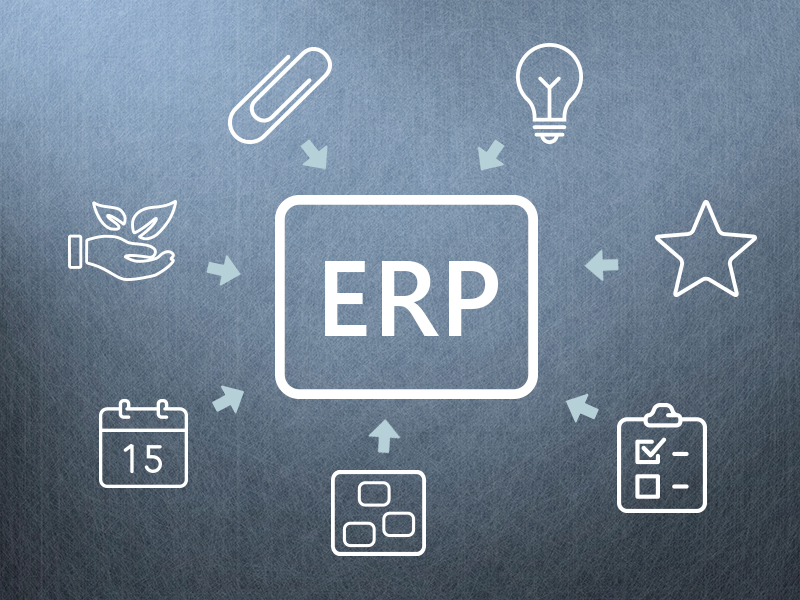
Have you ever felt like running a business is like juggling balls? On one side, you have to think about inventory, on another, you’re stressed about financial reports, not to mention dealing with employees who can sometimes create drama.
Many business owners struggle because their data is messy and not centralized. According to many technology experts, data integration is the key if you want your business to scale up instead of just staying stagnant.
This is where an ERP system comes in, bringing all your operations together into one organized and automated system. If you’re still relying on manual methods, be prepared to feel overwhelmed because your competitors are likely already moving faster.
What is ERP?
ERP or Enterprise Resource Planning is the central brain of your business. Imagine an ERP system as a large hub that connects all departments, from warehouse and sales to accounting.
Where you used to have to check manuals one by one to find out your remaining stock, now you can see everything on a single screen. Essentially, this is about having complete control over every transaction.
Today, using an ERP system has become a basic necessity. Culinary businesses and SMEs are starting to realize that without a well-organized system, they will get stuck handling administrative tasks without real revenue growth.
That’s why with this software, workflows become clearer, more transparent, and of course, minimize human error.
ERP Functions in Integrating Business Processes
After understanding the definition, you might ask, "Is it really that powerful?" The answer is, absolutely! The main function of ERP system is to destroy the barriers between departments or what is usually called data silos.
Does it often happen that the marketing team is already selling like crazy, only to find out the warehouse team is out of stock? Well, that kind of thing won't happen if the system is integrated.
The impact is between the front (front-end) and back (back-end) so it's getting smoother. When an order comes in, ERP system will immediately send a signal to the procurement department to check stock, then it will be automatically recorded in the financial journal.
Everything flows automatically, without you having to constantly ask staff via chat, which often gets lost. This efficiency will make your business appear much more professional to customers.
Read also: Want to Increase Sales? Try These 10 Promotional Strategies to Boost Sales!
How Does an ERP System Work?
The way an ERP system works is actually very systematic, yet simple for users. At its core is a centralized database.
Whenever new data is entered, it is instantly distributed to other parts of the system that need it in real time.
For example, in restaurant operations, when the cashier clicks "pay," the system doesn't just print a receipt.
It instantly reduces the inventory of raw materials (such as meat or vegetables), enters the amount into the profit and loss report, and updates performance.
This synchronous working method means you no longer have to wait until the end of the month to find out whether your business made a profit or a loss this month.
Types of ERP Based on Implementation
You need to know that not all ERPs are created equal. There are several types of implementations that you can tailor to your budget and needs:
1. On-Premise:
Well, this is the conventional type where the software is installed on your own server. You have full control, but it requires an IT team to maintain it.
2. Cloud-Based (SaaS):
If this is what's really trending, you just have to subscribe. The data is stored in cloud, so you can access it from anywhere as long as there is internet.
3. Hybrid:
A combination of both. It is usually used by companies that want the flexibility of the cloud while still keeping highly sensitive data on their own physical servers.
Benefits of ERP Systems for Business

Sumber: istockphoto
The most noticeable benefit is significant time savings. With an ERP system, you no longer need to input the same data multiple times across different applications.
In addition, your data accuracy will improve drastically. No more confusing stock discrepancies during stock opname. Data security is also much stronger, as modern software typically uses high-level encryption to protect sensitive business information.
Most importantly, you can make faster business decisions. Want to open a new branch? Just check the branch performance data in the system and you'll get data-driven answers.
Benefits of ERP for Restaurant and Culinary Businesses
In the fast-moving culinary world, an ERP system is like oxygen. It allows you to manage recipes in detail, so every portion of food sold automatically calculates how many grams of ingredients are used.
This is extremely helpful in controlling food costs and preventing them from rising unnecessarily. It becomes even more important if you have multiple outlets, such as in food courts. Monitoring each outlet manually via phone is exhausting and prone to manipulation.
With system integration, you can view real-time sales reports from all branches simultaneously. This is the secret behind how large restaurant chains expand quickly without losing control over quality and financial performance.
Read also: Food Product Bundling Strategy for Double Profits
Challenges of Managing a Business Without an ERP System
If you’re still relying on manual methods, the challenges will only grow as your business expands. The risk of data loss is high, whether from missing records or corrupted Excel files.
Team coordination will also become slower. Imagine customers having to wait just because the cashier needs to run to the kitchen to check stock manually.
In today’s fast-paced world, even a slight delay can cause customers to switch to competitors.
Don’t let your business slowly decline just because you’re hesitant to invest in technology. Start investing now and keep up with the times so you can stay competitive.
FAQs About ERP Systems
1. What is an ERP system?
An ERP system is software used to integrate various business processes into a single system. Everything from finances and inventory to operations can be managed centrally.
2. How does the ERP system work?
ERP works by connecting every division into a single database. Incoming data is immediately updated and can be accessed in real time by the relevant teams.
3. What are the types of ERP systems?
There are several types of ERP, including cloud-based, on-premise, and hybrid. Each type has its own advantages depending on business needs.
4. What are the main benefits of an ERP system for business?
ERP helps improve efficiency, reduce data errors, and speed up decision-making. It also makes businesses more organized and easier to grow.
Conclusion & Best Solutions for Your Culinary Business
Using an ERP system is a smart way to control culinary business operations.
A cloud-based ERP system like ESB Core can improve efficiency and reduce data errors in your business.
With ESB Core, all business processes, from finance to inventory management, can be monitored in real time and with high accuracy. Business owners can also manage multiple outlets more easily through a centralized system.
It’s time to switch to a more automated, efficient, and integrated system to drive business growth.
Consult your business needs and contact the ESB team for the best solutions.


