
Looking for a Balinese noodle restaurant that has been known across generations while offering a more modern restaurant concept? Bakmi Akiu can be an interesting name to add to your culinary list in Denpasar.
Starting as a simple noodle business, Bakmi Akiu has managed to preserve its distinctive flavors while growing into a business with multiple outlets. This journey is not only about maintaining its signature taste, but also about how operations, production, distribution, and data management can become increasingly structured.
So, what is the story behind Bakmi Akiu, what menu items are worth trying, and how does the business maintain consistency as it continues to expand its outlets? Let’s take a closer look at the story of Bakmi Akiu Bali and the operational strategies behind its growth.
Getting to Know Bakmi Akiu Bali
The name Bakmi Akiu has been part of Denpasar’s culinary journey for decades. Bakmi Akiu describes itself as a legendary noodle restaurant in Denpasar that has been around since 1985. The name “Akiu” itself is the nickname of Suleman Budjang, the founder of the business, who came from Bangka.
Its journey began even earlier, in 1978, when Suleman Budjang sold noodles using a mobile food cart around various parts of Denpasar. Several years later, in 1985, he opened his first noodle shop on Jalan Nangka.
The business journey went through several changes. The business once had to stop operating due to the founder’s health condition before being continued by the next generation in 2008. The pandemic in 2020 caused operations to stop again, before Bakmi Akiu eventually returned in 2023 with a more modern concept.
This rebranding and reopening became an important point in Bakmi Akiu’s journey. The signature flavors that had become part of its long-standing identity were preserved, while the customer experience was adapted to better meet modern needs. Today, Bakmi Akiu’s official website also lists several outlets across Bali, including Nangka, Sesetan, Marlboro, Barito, Jimbaran, Gianyar, and Batubulan.
Therefore, Bakmi Akiu’s positioning is not simply about bringing back nostalgia for traditional noodles. The brand is attempting to combine its culinary heritage with a more scalable food business model.
Bakmi Akiu Menu Worth Trying
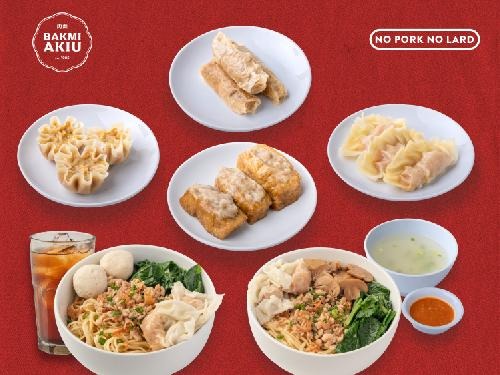
Source: gofood.co.id
Bakmi Akiu’s menu is not limited to just one type of noodle. There are various noodle options, side dishes, and beverages that customers can choose according to their preferences. Some options worth trying include:
1. Chicken Noodles
A classic choice for those who want to enjoy the signature taste of Bakmi Akiu without too many additional toppings. The noodles are served with chicken toppings, vegetables, spring onions, fried onions, and chicken broth.
2. Chicken Noodles with Chili Oil
For those who enjoy savory flavors with a spicy kick, the chili oil variant can be a great choice. This menu is also listed as one of Bakmi Akiu’s best sellers, making it suitable for anyone who wants to try one of its signature dishes.
3. Special Chicken Noodles
If you want more toppings, the Special Chicken Noodles offer a combination of chicken, mushrooms, chicken dumplings, chicken meatballs, and other accompaniments. This option is suitable for anyone looking for a more complete noodle dining experience.
4. Chicken Siomay
Bakmi Akiu is not only about noodles. Side dishes are also an important part of the dining experience. Chicken siomay is one of the popular menu items and is also listed as a best seller alongside the chili oil noodles.
5. Gyoza and Other Side Dishes
For those who want to share food or simply add some snacks to their meal, Bakmi Akiu also offers options such as gyoza, fried dumplings, nori crab, chicken feet, chicken spring rolls, and various other dim sum dishes.
Bakmi Akiu Sesetan and Locations in Denpasar
One of the well-known locations is Bakmi Akiu Sesetan at Jalan Raya Sesetan No. 265, Sesetan, South Denpasar. This outlet is one of the options for customers who want to enjoy Bakmi Akiu’s menu in the South Denpasar area.
Besides Sesetan, Bakmi Akiu also has several other locations in Denpasar and surrounding areas. There is the Nangka branch on Jalan Nangka, Ayani on Jalan Ahmad Yani Utara, Marlboro on Jalan Mahendradatta Selatan, and Barito in the Renon area. Outside Denpasar, the brand is also listed in Batubulan and several other locations.
This expansion shows how a business that initially relied on a single noodle shop can grow into an outlet network. The challenge is no longer simply attracting new customers, but also ensuring that customers receive a relatively consistent experience and quality at every location.
This is where operational management begins to play an increasingly important role.
Read also: Modern Warmindo Innovation! Here's How to Get More Attention to Your Stall
Bakmi Akiu Central Kitchen: Maintaining Consistency Across Multiple Outlets
When a culinary business has only one outlet, the production process may be relatively easy to monitor directly. However, as the number of outlets grows, the requirements for raw materials, standardized recipes, production processes, and distribution also become more complex.
For this reason, Bakmi Akiu’s central kitchen concept plays an important role in supporting its business operations. According to information from Bakmi Akiu, its noodles are produced through a central kitchen before being distributed to its outlets. This approach helps the business maintain freshness while ensuring product consistency across different locations.
A central kitchen is not simply a place for cooking food in large quantities. For a multi-outlet business, a central kitchen can also serve as a control point for standardizing ingredients, recipes, portions, and distribution processes. With a more centralized process, individual outlets do not need to carry out the entire production process from the beginning.
The more outlets a business operates, the more important it becomes to have a system that provides visibility into stock requirements and product movements. Without structured management, increasing the number of outlets can actually make operations more difficult to control.
The Technology Behind Bakmi Akiu’s Operations
Expanding the number of outlets also increases the need for operational data. A business needs to know which products sell the most, which products move slowly, how each day’s sales perform, and what needs to be improved in its sales strategy.
At this stage, technology can help culinary businesses reduce their dependence on manual processes. Transaction data from multiple outlets can serve as a basis for identifying sales patterns and determining the next steps.
For businesses with multiple outlets, a point-of-sale system no longer functions only as a payment recording tool. Transaction data can be used to monitor fast-moving and slow-moving products, evaluate outlet performance, and help teams determine promotional strategies.
The faster data becomes available and the easier it is to understand, the faster teams can make decisions. For example, when a product shows low sales, the team can evaluate its performance and consider a more appropriate promotional strategy.
Bakmi Akiu x ESB Testimonial Video
The use of technology in Bakmi Akiu’s operations is also part of its collaboration story with ESB. One of the key aspects highlighted is how the system helps the team access and analyze sales data more conveniently.
Farid, Supervisor at Bakmi Akiu, shared his experience using ESB:
“ESB itself, in my opinion, is very helpful. Perhaps because the database is very large, it has the capacity to store a lot of data. In my previous job, the system was still manual. So, when we wanted to retrieve data, there was a lot of work involved, and we had to do it one by one. With ESB, it is very practical. The sales data is updated every day. And it is not just updated, it is also detailed. ESB directly displays the daily data, including fast-moving and slow-moving products. We usually pull the slow-moving product data weekly. We normally have meetings where we can discuss how to increase sales for products that do not sell well, usually through promotions. So, it has really helped us a lot.”
This testimonial shows that the need for technology in the culinary business is not simply about replacing manual record-keeping. More importantly, it is about how the collected data can be used to help teams understand business conditions and make decisions.
If you want to see the full story of how ESB is used in Bakmi Akiu’s operations, you can watch the complete testimonial video here:
Watch the Bakmi Akiu x ESB Testimonial Video on YouTube
Inspiration for Multi-Outlet Culinary Business Owners
Bakmi Akiu’s journey shows that growing a culinary business does not stop once a brand successfully attracts customers. The next challenge emerges when the business starts to grow and operate more outlets.
More branches mean more transactions, employees, raw materials, menu items, and data that need to be managed. If each process is still handled separately or manually, it becomes increasingly difficult for teams to gain a comprehensive view of the business.
Therefore, culinary business owners need to start considering their systems as their business enters the expansion stage. A central kitchen can help maintain production standards, while digital systems can help connect transactions and operational activities with data that is easier to monitor.
With a combination of standardized processes and the right technology, expansion does not simply mean opening more outlets. The business also gains a stronger foundation for maintaining quality, controlling operations, and making data-driven decisions.
FAQ About Bakmi Akiu
1. Where is Bakmi Akiu located?
Bakmi Akiu has several outlets across Bali. In the Denpasar area, some of its locations include Sesetan, Nangka, Ayani, Marlboro, and Barito. Outlet locations may change and expand, so customers can check the latest outlet list through Bakmi Akiu’s official channels.
2. What menu items are available at Bakmi Akiu?
Bakmi Akiu’s menu includes various noodle options such as Chicken Noodles, Special Chicken Noodles, Chicken Mushroom Noodles, and Chicken Dumpling Noodles. Side dishes such as chicken siomay, gyoza, dumplings, and various dim sum options are also available.
3. Is Bakmi Akiu considered a Balinese noodle restaurant?
Bakmi Akiu is known as one of the legendary noodle restaurants in Denpasar and has been part of Bali’s culinary journey for decades. Its distinctive character comes from the family’s recipes and business journey, which have developed in Bali.
4. What is the function of a central kitchen?
A central kitchen functions as a main kitchen that helps businesses manage production and distribute ingredients or products to multiple outlets. For multi-outlet businesses, this concept can help maintain standards, improve production efficiency, and ensure consistent quality.
Conclusion
Bakmi Akiu’s journey shows how a culinary business can grow from a simple operation into a multi-outlet brand without losing the signature flavors it has built over decades. Behind this expansion, increasingly structured management of production, distribution, transactions, inventory, and data is required.
For culinary businesses that are beginning to grow into multi-outlet operations, technology can serve as an important foundation for keeping operations under control. ESB POS is a holistic point-of-sale application designed specifically for culinary businesses. It helps manage transactions, menus, packages, promotions, tables, multiple cashiers, loyalty programs, reservations, digital vouchers, and integrations with GrabFood, GoFood, and ShopeeFood. ESB POS also comes with customer display features and a deposit system for food court concepts.
Meanwhile, ESB Core helps businesses manage broader processes, including inventory, COGS, stock movements across all branches, stock opname, and financial reports such as balance sheets, profit and loss statements, trial balances, cash flow management, and integrated multi-company reports. With data that can be monitored in real time from anywhere, business owners can make faster and more measurable decisions.
If your culinary business is growing and needs a system that can keep up with the complexity of multi-outlet operations, it is time to learn more about ESB’s solutions. Contact the ESB team to find the solution that best fits your business needs.


