
Have you ever heard the term walk-in guest in restaurant operations? For culinary business owners, this term is important to understand because it is directly related to how restaurants receive, manage, and serve customers who come without a reservation.
Simply put, walk in means coming directly without an appointment or prior booking.
In the restaurant context, a walk-in guest is a customer who comes directly to the restaurant without making a reservation beforehand.
This type of customer is commonly found in restaurants, cafés, coffee shops, and dining places with strategic locations.
For example, a customer passes by a restaurant, feels interested in the menu or atmosphere, then decides to enter and dine in.
Although walk-in guests come spontaneously, they play an important role in restaurant operations.
If managed properly, walk-in customers can help increase traffic, fill empty tables, and drive daily sales.
What is a Walk-in Guest in a Restaurant?
In the restaurant industry, a walk-in guest is a customer who comes directly without a reservation.
They do not book a table in advance, but come to the restaurant and wait for an available table.
So, if a customer suddenly comes to a restaurant, asks whether there is an available table, and orders food on the spot, that customer is considered a walk-in guest.
From this, we can understand that walk in means coming directly. In restaurant operations, this term is used to differentiate spontaneous customers from customers who have already made a reservation.
Walk-in guests are usually more common in restaurants with high traffic, busy locations, or easy access.
Examples include restaurants in malls, office areas, tourist areas, or coffee shops located on main roads.
Read Also: Customer Retention Is Key to Business Success, Here's How to Improve It!
The Difference Between Walk-in Guests and Reservations

Source: Istockphoto
To understand it more clearly, you need to know the difference between walk-in guests and reservation customers.
Reservation customers are customers who have booked a table before coming. Usually, they determine the arrival time, number of guests, and sometimes specific needs such as a non-smoking area, private room, or baby chair.
Meanwhile, walk-in guests come without making any prior booking. They usually come directly to the restaurant and ask about table availability.
This difference is important because both require different management approaches. Reservations help restaurants predict the number of customers at a certain time. Meanwhile, walk-in guests require operational flexibility because their arrival cannot always be predicted.
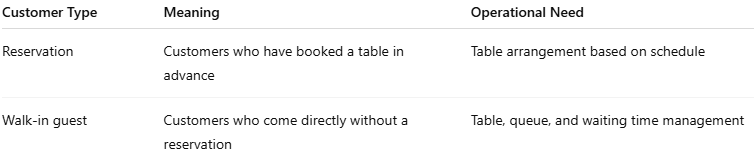
By understanding this difference, restaurants can better manage table capacity, staffing, and service flow.
Why Are Walk-in Guests Important for Restaurants?
Walk-in guests play an important role in the restaurant business because they can become an additional source of traffic.
Not all customers come with a plan. Many customers choose a restaurant spontaneously because of its location, appearance, friend recommendation, or because the restaurant looks lively.
First, walk-in guests can help increase daily sales. If there are empty tables not filled by reservations, walk-in customers can help maximize restaurant capacity.
Second, walk-in guests can be an opportunity to gain new customers. Customers who come spontaneously may return if they are satisfied with the food, service, and dining experience.
Third, walk-in guests help keep the restaurant atmosphere lively. A busy-looking restaurant can often attract more people to come in.
Fourth, walk-in customers can also indicate the restaurant’s appeal. If many people come without a reservation, it may mean that the location, branding, menu, or restaurant appearance is already attractive to potential customers.
Challenges in Managing Walk-in Guests
Although they can be a great opportunity, walk-in guests also come with their own challenges. Since they come without a reservation, restaurants need to be ready for sudden changes in customer volume.
The first challenge is table availability. When the restaurant is full, walk-in guests have to wait. If the waiting time is too long and not managed properly, customers may choose to leave for another restaurant.
The second challenge is queue management. Without a clear queue system, customers can feel confused or unappreciated. This can lower the quality of the customer experience.
The third challenge is staff coordination. The service team needs to know which tables are occupied, which tables are being cleaned, and which tables are ready to use. If coordination is not organized, service can feel slow.
The fourth challenge is balancing reservations and walk-ins. Restaurants need to make sure customers with reservations still get their tables on schedule without ignoring walk-in guests who come directly.
How to Manage Walk-in Guests Effectively
To turn walk-in guests into an opportunity, restaurants need a clear management strategy. Here are several ways to do it.
1. Prepare a Clear Queue System
If the restaurant is full, walk-in guests need clear queue information. Let them know the estimated waiting time and make sure the queue order is recorded properly.
A clear queue system helps customers feel more at ease because they know their position.
2. Provide Transparent Waiting Time Information
Do not give an overly optimistic estimate if tables are not yet available. It is better to provide a realistic estimate so customers do not feel disappointed.
For example, staff can say:
“At the moment, the estimated waiting time is around 15–20 minutes.”
Simple communication like this helps manage customer expectations.
3. Optimize Table Layout
Restaurants need to have a flexible table layout. For example, tables for two can be combined for small groups, or larger tables can be rearranged according to customer needs.
A flexible layout helps restaurants serve more customers without compromising comfort.
4. Train Staff to Be Responsive
Staff need to be trained to welcome walk-in guests warmly and quickly. First impressions are very important, especially for customers who are visiting for the first time.
A simple greeting, clear information, and responsive service can make customers feel appreciated.
5. Monitor Restaurant Capacity in Real Time
Restaurants need to know table conditions quickly. Which tables are occupied, which are almost finished, which are being cleaned, and which are ready for new customers.
With proper monitoring, staff can manage walk-in guests more efficiently.
Read Also: Want Loyal and Returning Customers? Implement a Customer Intimacy Strategy Now!
The Relationship Between Walk-in Guests and Customer Experience

Source: Istockphoto
Customer experience is greatly influenced by how restaurants welcome and manage customers. For walk-in guests, the first experience begins as soon as they enter the restaurant.
If customers are welcomed immediately, given clear table information, and served politely, they will feel comfortable even if they have to wait.
On the other hand, if customers arrive but no staff greets them, the queue is unclear, or waiting time estimates keep changing, their experience can become negative.
That is why managing walk-in guests is not only about providing a table. More than that, restaurants need to make sure customers feel taken care of from the start.
The Role of Walk-in Guests in Increasing Revenue
Walk-in guests can help increase restaurant revenue because they fill sales opportunities that may not be recorded in reservations.
For example, if a reservation customer cancels or there are empty tables during certain hours, walk-in guests can help fill those slots so restaurant capacity remains productive.
In addition, walk-in guests often come because of spontaneous decisions. They may be interested after seeing a busy restaurant, an attractive menu, or an easily accessible location.
If their first experience is positive, walk-in customers have the potential to become loyal customers. They may also recommend the restaurant to friends, family, or coworkers.
In other words, walk-in guests are not only additional customers, but also an opportunity to expand the customer base.
The Role of Technology in Managing Walk-in Guests
Technology helps restaurants manage walk-in guests more efficiently, especially when the outlet is busy. With the right system, restaurants can manage queues, speed up ordering, and keep the customer experience comfortable.
ESB Kiosk can help customers place orders independently without waiting too long for staff. Meanwhile, ESB Lounge helps manage customer queues so they are more organized and clear.
With the support of ESB Kiosk and ESB Lounge, restaurants can reduce long queues, improve service flow, and make walk-in customers feel more comfortable from the beginning.
FAQ Seputar Walk-in Guest
1. What does walk-in guest mean?
A walk-in guest is a customer who comes directly to a restaurant without making a reservation beforehand. They come in and wait for an available table.
2. What does walk in mean in a restaurant?
In a restaurant, walk in means customers come directly without a prior booking or reservation.
3. What is the difference between walk-in guests and reservations?
Walk-in guests come without a reservation, while reservation customers have already booked a table before arriving. Reservations are more planned, while walk-ins are spontaneous.
4. Why are walk-in guests important for restaurants?
Walk-in guests are important because they can help increase traffic, fill empty tables, increase sales, and create opportunities to gain new customers.
5. How do you manage walk-in guests properly?
Restaurants can manage walk-in guests with a clear queue system, transparent waiting time estimates, responsive staff, and real-time table capacity monitoring.
Conclusion
Walk in means coming directly without an appointment or prior reservation. In the restaurant context, walk-in guests are customers who come directly and wait for table or service availability.
Walk-in customers can be a great opportunity to increase traffic and sales. However, restaurants need a system that can properly manage queues, capacity, and service flow.
With ESB Kiosk and ESB Lounge, restaurants can manage walk-in customers more efficiently. ESB Kiosk helps speed up self-ordering, while ESB Lounge helps make queues more organized.
Contact the ESB Team now and consult your culinary business needs!


